
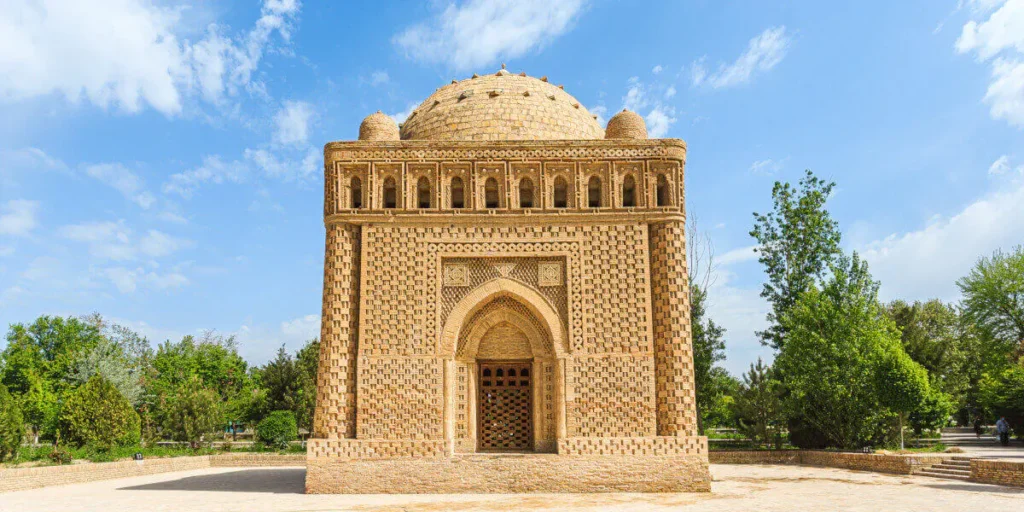
Ismail Samani Mausoleum
The Ismail Samani Mausoleum is one of the oldest and most remarkable architectural monuments in Bukhara, dating back to the 9th–10th centuries. It was built as the final resting place of Ismail Samani, the founder of the Samanid Dynasty, and stands as a symbol of the revival of Persian culture and architecture in the region after the Arab conquest.
The mausoleum is considered a masterpiece of early Islamic architecture, distinguished by its perfectly balanced proportions and innovative use of baked brick. Unlike later structures that rely heavily on colorful tiles, this building achieves its beauty through intricate brick patterns, forming geometric designs that change appearance depending on the light. Its cubic shape topped with a dome reflects both pre-Islamic and Islamic architectural traditions, making it unique in Central Asia.
Historically, the mausoleum survived numerous invasions and natural changes, partly because it was buried under layers of sand for centuries, which protected it from destruction during events such as the Mongol invasions. This preservation makes it one of the best-kept examples of early medieval architecture in the region.
Today, the Ismail Samani Mausoleum is located in a peaceful park area and remains one of the most visited landmarks in Bukhara. Visitors are drawn by its historical significance, architectural elegance, and serene atmosphere, making it an essential stop for anyone exploring the rich cultural heritage of Uzbekistan.