
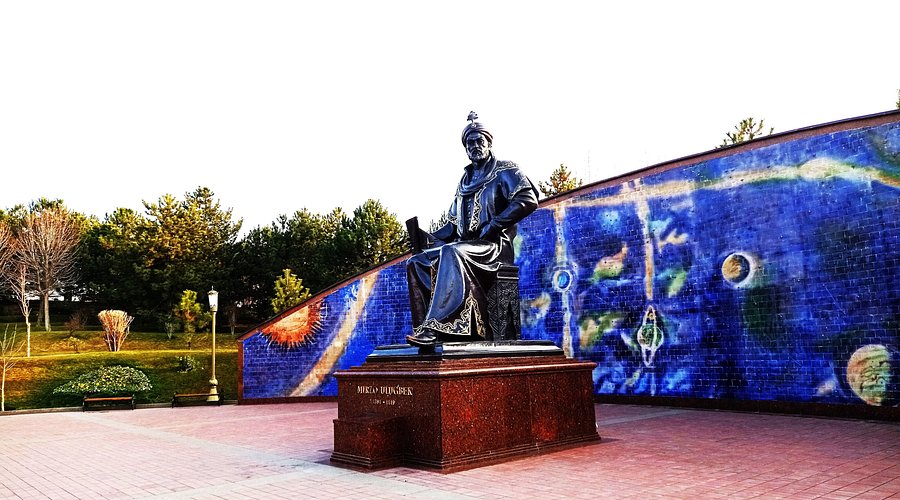
Ulugh Beg Observatory
The Ulugh Beg Observatory is one of the most important scientific monuments in Samarkand, representing the golden age of astronomy in Central Asia. It was built in the 15th century by Ulugh Beg, a Timurid ruler who was also one of the greatest scientists and astronomers of his time.
The observatory was part of Ulugh Beg’s strong interest in mathematics and astronomy. Unlike many rulers of his era, he personally studied the stars and gathered a group of leading scholars to work with him. Together, they created highly accurate astronomical tables known as the Zij-i-Sultani, which were used for centuries in the Islamic world and beyond.
Architecturally, the observatory was a massive circular structure equipped with a giant astronomical instrument called a sextant, which was partially built into the ground. This instrument allowed astronomers to measure the position of stars and planets with remarkable precision for that period. The scale and accuracy of the building made it one of the most advanced observatories in the medieval world.
After the death of Ulugh Beg, the observatory was destroyed, and its exact location was lost for centuries until it was rediscovered in the early 20th century. Today, only the underground remains of the main instrument survive, preserved as a museum.
Currently, the Ulugh Beg Observatory is a popular historical site and museum that attracts visitors interested in science, history, and astronomy. It stands as a powerful symbol of Samarkand’s intellectual heritage and the scientific achievements of the Timurid era.