
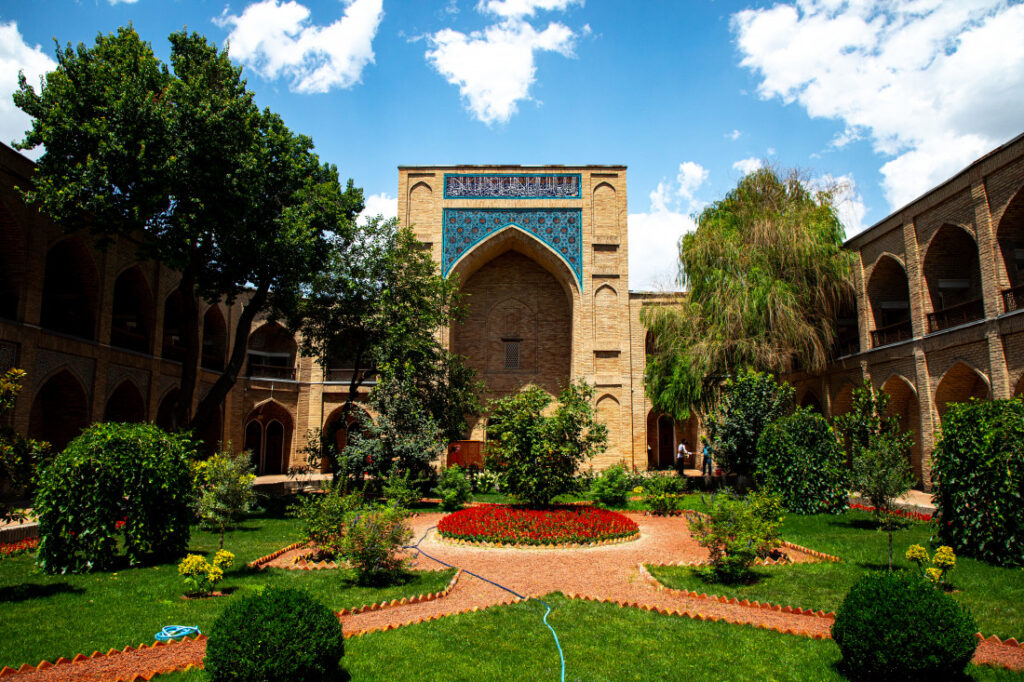
Kukeldash Madrasa
The Kukeldash Madrasa is one of the oldest and most significant Islamic educational institutions in Tashkent, reflecting the rich architectural and cultural heritage of the city. Built in the 16th century during the rule of the Shaybanid dynasty, the madrasa became an important center of religious learning and scholarship in Central Asia.
The madrasa was constructed under the patronage of Kukeldash, a high-ranking official and close advisor to the ruler. Over the centuries, it served not only as a place for Islamic education but also as a social and cultural center where students studied theology, literature, philosophy, and other sciences.
Architecturally, the Kukeldash Madrasa is a classic example of Central Asian Islamic design. The building features a large entrance portal, a spacious inner courtyard, and rows of hujras, or student rooms, surrounding the complex. The facade is decorated with traditional geometric patterns, glazed tiles, and ornamental brickwork that reflect the artistic style of the period.
Throughout its history, the madrasa survived earthquakes and periods of decline, undergoing several restorations to preserve its historical appearance. Its elevated position near the old Chorsu district gives visitors a beautiful view of the surrounding historical area.
Today, the Kukeldash Madrasa remains one of the most recognizable landmarks in Tashkent and an important symbol of the city’s Islamic and educational heritage. It continues to attract tourists, historians, and visitors interested in the rich history and architecture of Uzbekistan.